Cruising the Dalmatian Coast of Croatia
The driver from the Lion-Queen boat line picked us up in Split after we returned our rental car and drove us to Trogir, where we boarded the boat which would be our home for the next 7 days. On the way to Trogir, our driver pointed out the 7th century viaduct that is still used to this day to bring water from the mountain rivers to Split. We arrived around 4 pm and as dinner was at 7 pm, we had a few hours to spend exploring Trogir, another UNESCO site.

Trogir is a very charming, small, well-preserved walled city on an island. The main square is at the site of the Roman forum, and the loggia dates from the 1300’s. The Romanesque Cathedral of St Lawrence and bell tower, also on the square, are the most famous monuments in Trogir. Located in the small alleys are several churches and restaurants. However, as Trogir is the port for the majority of the cruises along the Dalmatian coast, it is touristy and crowded.
Our boat was a beautiful wooden boat which had 6 cabins. The week we were on board (mid-June) was the beginning of the season and there were only two other passengers and the crew of three. Our itinerary for the week was to have breakfast on the boat before we sailed to our next island destination, arriving around noon. Following lunch onboard, we explored the island and had dinner on our own at one of the local restaurants. It was a great itinerary as it allowed ample time on each island to experience the island and enjoy the local cuisine and night life.
We sailed from Trogir around 9 am the next morning reaching the town of Milna on the island of Brac around 12:30 pm. Brac is one of the larger islands of the Dalmatian coast. Milna is a small town of around 800 inhabitants founded in the 15th century by sheep herders. It is on the western part of Brac and has its own dialect. There were very few cars. After lunch, we walked around the town, along the promenade, past where the road turned up the hill unto a gravel road towards the point of the island. We probably covered 3 to 4 miles by the time we returned.
We ate at a small pizzeria next to our boat, Pizzeria Silka. Pizza is great here. Also had an arugula salad with parmesan cheese and olives, wine and a very large beer for 150 Kr, or about USD 30.
The next morning we left Milna and sailed to Jelsa, a small town on Hvar island. We walked to all three churches in the center of town, but none were open, and then walked up the hill through a pine forest to another church. Along the way were several gravel beaches.
We dined at Teraswa Paradiso up the hill a few blocks with a beautiful view over the water. We shared a Greek salad and seafood spaghetti with a liter of white wine for 190 KHR.

Our next stop was the town of Korcula on the island of Korcula. This medieval town, located on a peninsula, is a walled city with round defensive towers. The main street runs through the city with side streets running down to the water. Marco Polo is reputed to have been born in Korcula, and the city has capitalized on his heritage. The city is very proud of its architectural accomplishments and cultural tradition. There are interesting courtyards from houses built 500 years ago. It’s very picturesque and very well preserved, but it does have a significant number of tourists.
Restaurants and bars were significantly more expensive than the other islands we have visited, but outside of the city walls and away from the crowds we were able to find food for a reasonable price.
The next morning we sailed to Vela Luca, a town on the other side of the island of Korcula. The town is relatively small and not too touristy. It appears to cater to those visiting via sailboat, not ferry. We walked up to the parish church of St Joseph, which was closed, but noticed a sign for an archeology museum 880 meters further on and decided to follow the concrete path. We arrived at Vela Spila (cave) which is about 130 meters above the bay of Kale. It’s a very old cave documenting that people lived here 1200 BC and is the best example of a Mesolithic cave in Europe. The striations of the various time zones are apparent. There are posters in English that give a good explanation of what happened during the various time periods. It is still being excavated. It’s small but interesting and definitely well worth the climb.
We had dinner at Pod Bore. A Greek salad and dish of cevapcici (grilled meat sausages) with a liter of wine was 190 KHR.

The next day we sailed back to the island of Hvar to the town of Hvar, which is one of the more popular destinations and a UNESCO site. It is definitely a jewel and understandable why it is popular. Although it was quite busy, it didn’t seem as touristy as Korcula. The Town Square is very large with the Cathedral of St Stephen and bell tower (built during the 16th and 17th centuries) at one end of the square. We picked up a map in the tourist office and began walking. The oldest theater in Europe, dating from 1612, which charges 15 KHR entrance fee, is located on the square. The Benedictine monastery on the left side and Franciscan monastery on the right side of town were not open as it was a religious holiday.
Before we hiked up to the fortress, we stopped for drinks in one of the bars in the square. The price of our drinks were double the price we paid in Vela Luka (67 vs. 33 KHR and the beer was larger in Vela Luka). We are in the tourist section for sure.
We walked up to the Spanjoia Fortress on top of the hill. Although it looks like quite a hike to the top, there is a paved path and it only takes 15 to 20 minutes to reach the fortress. The early fort dates from the 13th century, but the present structure is mostly from the 16th century. The view of the city walls and harbor are definitely worth the walk up. The dungeons of the fortress, or prison as they referred to it, are very impressive. We then walked back down through the back streets and along the promenade on the waterfront. There are several hotels and beach clubs with cushions on the rocks for sun bathing. The beach is pebbly but pretty.
We stopped at a small café on the plaza ad shared a grilled calamari which was delicious and Greek salad. With a wine and beer, the bill was 180 KHR. Not too bad for a tourist town.
For our last day on the boat, we went to the island of Solta. It’s small and quiet, a contrast to Hvar. The next morning we sailed from Solta back to Trogir arriving at 9 am to the hustle and bustle of returning cruises. We got a taxi to the airport where we picked up our next rental car and took A1 south towards Dubrovnik. After an hour’s drive A1 ended and we were on a local road along the coast again.
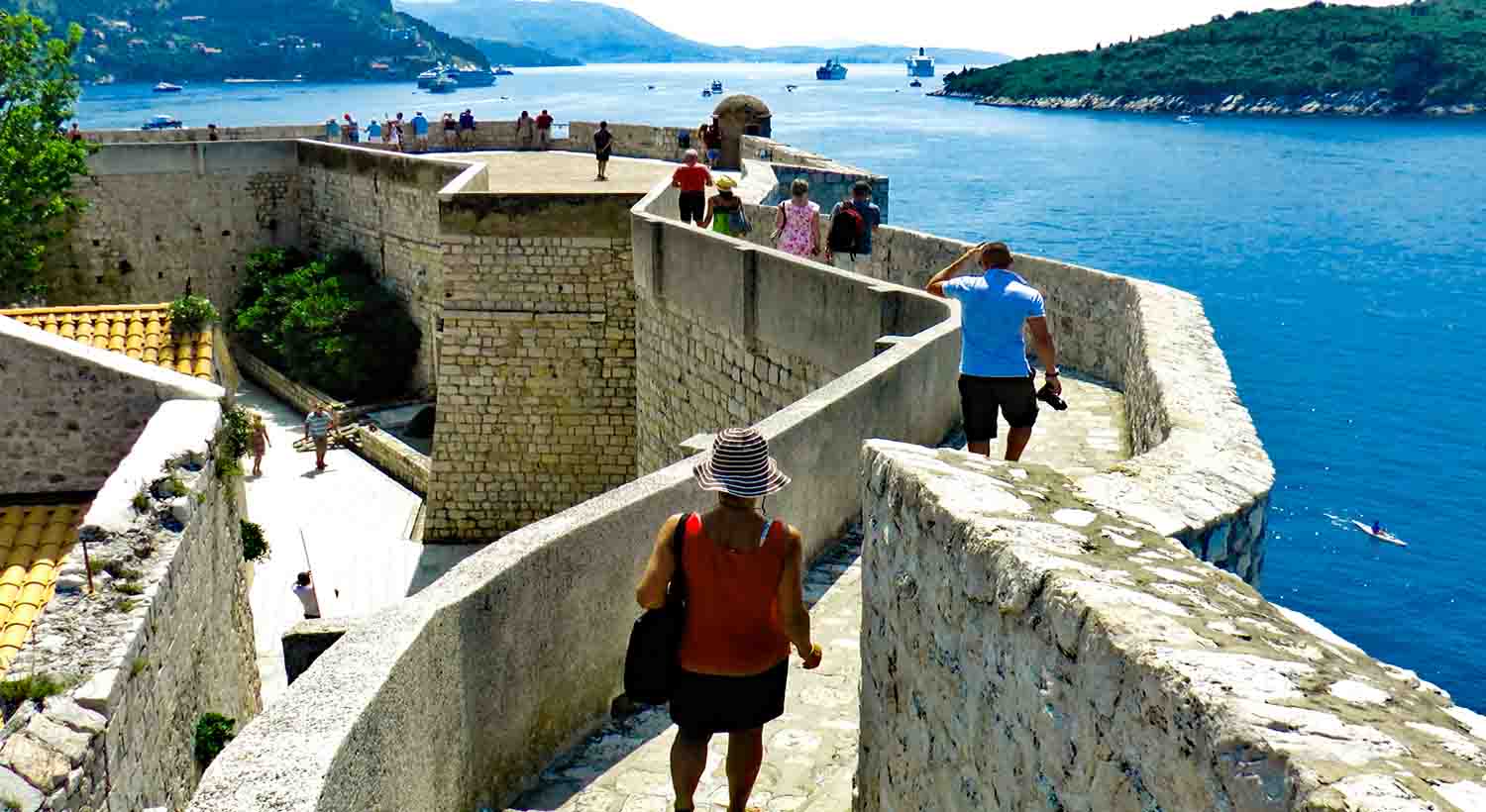
We stopped in Ston which is known for the second biggest wall after the Great Wall in China. It is very impressive and looks very much like the Great Wall in China. Unfortunately, we did not have the time to walk it.
We continued on the coastal drive to Arboretum Trsteno which is only 20 km outside of Dubrovnik. The town, originally a fishing village, attracted several wealthy Dubrovnik residents who built summer villas. The Arboretum was laid out in 1494 at the villa which was a summer residence of Ivan Marinov Gucetic Gozze. Numerous exotic seeds and plants were brought back by ship captains and planted here, so the current garden reflects 5 centuries of evolution. The Cypress trees in the Arboretum are 150 years old, and one Cypress tree along the road is 500 years old. The aqueduct which supplied water to the original garden was converted into a Baroque fountain in the 1700’s. After spending an hour there, we continued on to Dubrovnik.
Excerpt from my article, A self-drive tour of Croatia plus a cruise along the Dalmation Coast, published in the August 2015 issue of International Travel News.